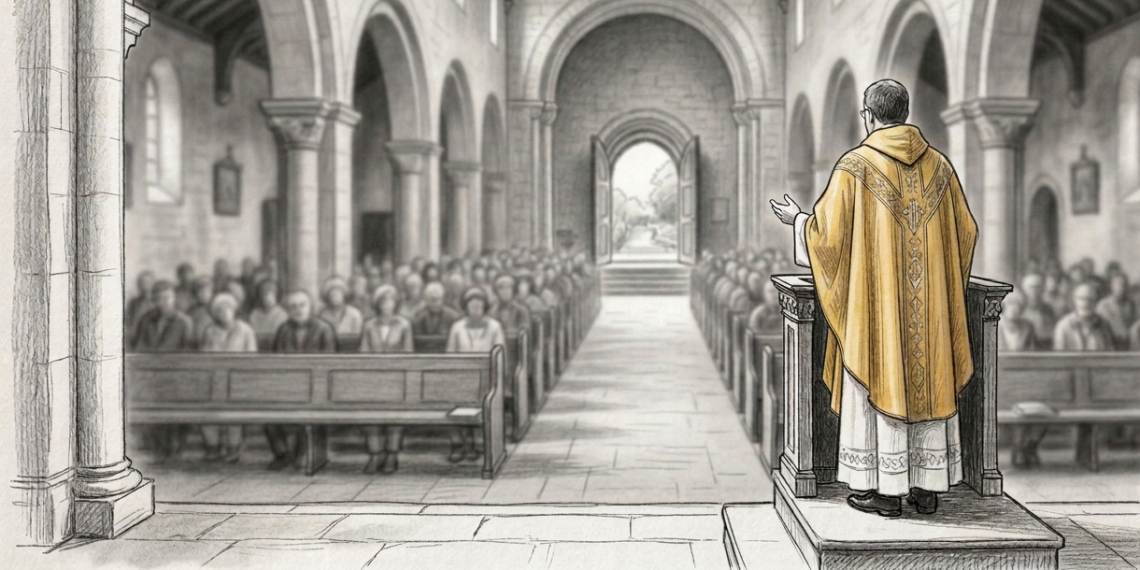
In 2006, I was invited to run a Lenten retreat for the Polish communities across Buckinghamshire. From that, my first ever visit to the UK, I remember two things that inspired me for the rest of my life. The first one was a domestic bean-to-cup coffee maker in the parish house where I stayed. It made such a deep impression on a coffee addict like me that I have dreamed of having one ever since. Eventually, I could afford one about ten years later. The second lifelong inspiration came from my host, a local English priest. Having read about the decline of the Catholic Church and generally Christianity in the UK, I had expected a mood of resignation, complaining and moaning I had been familiar with in my own priestly circles back in Poland. I was profoundly impressed by this priest’s cheerful and hopeful approach to his ministry and pastoral challenges. His attitude wasn’t that of decline management but of patient development and buildup of his parish community. I realised then that, despite coming from an overwhelmingly Catholic country, my mind was set towards a rather hopeless and inevitable downward spiral of decline. I can’t really put into words how huge the contrast was between us.
It took me quite a long time, through reflection and an actual move to Scotland, to realise why I was then so pessimistic. From my priestly training and early career, it was all about the numbers. The main metric of any pastoral success was the size of the crowd gathered, bussed, or drawn to the event, be it a Sunday Mass, a pilgrimage, First Communion or the Sacrament of Confirmation and so on. There was an unofficial competition to see who could get the greatest number of people, with bragging rights for the winner. For a young, enthusiastic priest eager to preach the gospel and bring people to Jesus, it was quite frustrating. That sense of failing was compounded by the occasional stumbling on biblical passages like today’s first reading, where St Peter’s first-ever sermon led to a mind-boggling outcome: “those who received his word were baptised, and there were added that day about three thousand souls.” I consider myself lucky if nobody leaves the Church after my sermon, never mind anyone joining in. It’s so easy to doubt yourself.
However, a combination of experience in ministry and in biblical studies showed me that things are more complex and that there isn’t a one-size-fits-all approach to ministry. When we look a bit closer at today’s first reading and more broadly, the New Testament, we can realise that, with regard to the apparently enormous growth of the primal Church – three thousand here, five thousand there – we are wrong to see it as converting to a brand new religion. In fact, all those people joined a new movement within traditional Judaism, not against it. They continued to attend the Temple in Jerusalem and synagogues. They kept Jewish religious practices and traditions even more eagerly than some of their fellow Jews because of their spiritual awakening through their faith in Jesus as the promised Messiah. To a great extent, it’s a process that happens all the time within any established religion. For example, the Middle Ages crusades, though eventually covered in infamy, were a massive movement within Christendom, as was the modern-day charismatic awakening a few decades ago, or the rise in popularity of the traditional Latin Mass today. The eventual separation of Judaism and Christianity was a much, much later development and was driven as much by politics as by religious differences. But that’s a story for another time.
Good Shepherd Sunday reminds us of a few truths important to both ordained ministers and laity. There’s only One Shepherd leading the community of the faithful, and that’s Jesus Christ: “By his wounds you have been healed. For you were straying like sheep, but have now returned to the Shepherd and Overseer of your souls.” Everyone else in leading roles, from the pope in Rome to a lay catechist in a small Scottish Highlands parish, exercises their ministry in connection with and by the power of the one and only Good Shepherd. None of us is the new messiah, but we serve the One. Then, there isn’t a one-size-fits-all model of ministry. While the pope can attract millions of people, as Pope Francis and St John Paul II did in their time, the unflashy, quiet ministry of a priest to a crowd of five in the Scottish Highlands is no less valuable. There’s a whole spectrum of communities that must be catered for in various, appropriate ways. The common factor in all those ministries must be selfless love: “Christ […] suffered for you, leaving you an example, so that you might follow in his steps.” We must pray for a new generation of brave men and women to respond to Jesus’ call to service, whether as priests, deacons, or religious. People who will bring to others the light of Christ, whether as powerful as stadium lights or as a flickering candle flame.
Image by Engin Akyurt from Pixabay
